
Pages Google Crawled But Not Ranked? A Gurugram SEO Fix
Open Search Console and you’ll see it staring back at you: pages crawled, pages indexed, zero traffic. That’s the classic crawled but not ranked problem, and it’s eating budgets across Gurugram right now. Google found your page. It read it. It just decided your page isn’t worth showing anyone.
Here’s the part that stings. You paid for content, maybe a whole site rebuild, and the pages sit in Google’s index like unsold inventory in a Udyog Vihar warehouse. Meanwhile a competitor two floors down on Golf Course Road ranks for the exact same keyword with half your word count. That’s not bad luck. That’s a signal Google is sending about quality, intent, or structure, and most business owners never read it correctly.
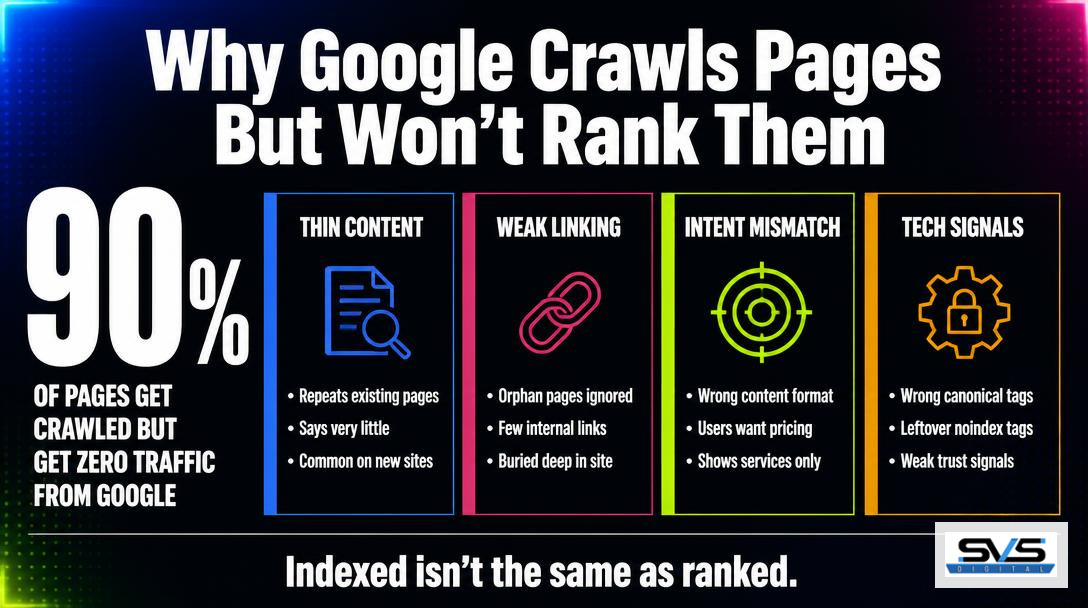
The fix isn’t mysterious once you know where to look. Four causes explain almost every case we’ve audited for clients across Cyber City and Sector 44: thin content, weak internal linking, intent mismatch, and technical signals quietly telling Google to hold back. Fix those and rankings usually move within weeks, not months.
Why Pages End Up Crawled But Not Ranked
It means Google’s crawler visited the page, stored a copy in its index, and then decided the content wasn’t good enough to compete for any real query. Indexing and ranking are two separate decisions. Google can index millions of pages a day without ever sending them a single visitor.
This matters because most site owners assume indexing is the finish line. It isn’t. It’s step one. Google’s own guidance on the index coverage report confirms this distinction directly, and treats “crawled, currently not indexed” and “indexed but not ranking well” as entirely different diagnostic states worth checking separately in Search Console’s index coverage report.
Start by pulling every URL from that report and sorting by impressions. Pages with zero or near-zero impressions over 90 days are your problem list. Everything that follows in this article is about clearing that list.
Thin or Duplicate Content Is the Most Common Cause
Pages that repeat what’s already on your site, or that say very little in 300 words, get indexed but ranked nowhere. We see this constantly on freshly launched sites where every service page uses the same three paragraphs with a swapped headline.
Google’s algorithms compare your page against dozens of competing results instantly. If your page adds nothing new, no pricing detail, no process explanation, no local example, it loses that comparison every time. New businesses are especially exposed here because they’re often racing to launch and treat content as a formality.
Rewrite thin pages with specifics: actual timelines, actual numbers, a named Gurugram client scenario if you can use one. If you’re building out a brand-new site, get SEO for new business websites baked in from day one instead of bolting it on after launch.
Your Internal Linking Structure Is Starving the Page
Orphan pages with few or no internal links rarely rank, even when they’re indexed and the content is decent. Google uses internal link volume as one signal of a page’s importance within your own site. If nothing points to it, Google assumes you don’t think it matters either.
We audited a Sector 44 manufacturing client last year whose top service page had exactly one internal link, buried in a footer. Three months after adding six contextual links from blog posts and the homepage, that page moved from position 41 to position 9. The content never changed.
Map your site’s link structure once a quarter. Every page that matters should get at least three or four internal links from relevant content. If you’re losing ground to rivals who seem to rank effortlessly, our breakdown on why competitors outrank you on Google covers this exact gap in more detail. For a full structural review, proper SEO services will map and fix your linking architecture, not just sprinkle keywords.
Search Intent Mismatch Kills Rankings Even With Good Content
If your page targets a keyword but the content doesn’t match what searchers actually want, Google parks it in the index without ranking it. This is intent mismatch, and it’s brutal because the content can genuinely be well written and still fail.
Say someone searches “website redesign cost Gurugram.” They want a number, or a range, fast. If your page is a 1,200-word essay on the philosophy of good design with no pricing mentioned anywhere, Google won’t rank it for that query no matter how polished the prose is. Intent trumps quality every time.
Audit the top five ranking results for each target keyword and note their format. Listicle? Comparison table? Pricing breakdown? Match that format, then differentiate on substance. Sites that recently went through a rebuild often lose rankings this way; our guide on recovering rankings after a redesign walks through the recovery steps, and website redesign and SEO services can prevent the drop from happening in the first place.
Technical Signals Are Quietly Telling Google to Hold Back
Canonical tags pointing to the wrong URL, leftover noindex tags from staging, or thin author and trust signals all tell Google not to bother ranking a page. These issues are invisible to a normal site visit, which is exactly why they go unnoticed for months.
We’ve found live sites where a developer forgot to remove a staging noindex tag three redeploys ago. The page looked fine. It read fine. Google simply wasn’t allowed to rank it, and nobody checked the source code to find out why.
Run a crawl with Screaming Frog or Search Console’s URL inspection tool on every underperforming page. Check canonicals, noindex tags, and whether the page has any author credibility signals at all. Fix what’s broken, resubmit for indexing, and watch the impressions graph for movement over the next three to four weeks.
Frequently Asked Questions
How long does it take to fix a page that’s crawled but not ranked?
Most pages show movement within four to six weeks once the underlying cause is fixed. Content and linking fixes tend to move faster than technical fixes, because Google has to re-crawl and reassess the page before any ranking change shows up, and that recrawl frequency depends on how often your site publishes new content overall.
Does local SEO for Gurugram businesses need different fixes than general SEO?
Yes, local intent signals matter more than most site owners realize. A Gurugram-based service page competing against national brands needs locality mentions, Google Business Profile consistency, and local backlinks, not just better on-page copy. Skipping that local layer is one of the most common reasons local pages stay stuck despite being technically sound.
Can a page get unstuck without building new backlinks?
Often, yes. Most crawled but not ranked issues we fix are content, intent, or linking problems internal to your own site, not a lack of external authority. Backlinks help once the on-site fundamentals are solid, but throwing links at a thin or mismatched page rarely moves it.
Diagnosing this yourself is possible, but it eats time you probably don’t have if you’re running a business in parallel. Our team at SVS Digital has run this exact audit for dozens of Gurugram sites, from Udyog Vihar manufacturers to DLF Phase startups, and we know which of the four causes to check first for your specific setup. Get a free consultation and we’ll tell you, honestly, what’s actually holding your pages back.
Ready to grow your digital presence?
Discuss your website, SEO or advertising goals with the SVS Digital team.
Contact UsRelated insights

5 Local SEO Gaps Costing You Ready-to-Buy Leads in Gurugram
A shopper in Sector 29 types “best gym near me” into Google, gets three results, and books a trial at the one that answers…

Why Competitors Outrank You on Google: A Gurugram SEO Fix
Type your main keyword into Google and there they are again, the same three names sitting above you in the Gurugram results. It stings…
How to Recover Rankings After Redesign: A Gurugram SEO Playbook
You redesigned your website, and now your traffic has fallen off a cliff. It happens more often than agencies like to admit. If you’re…